
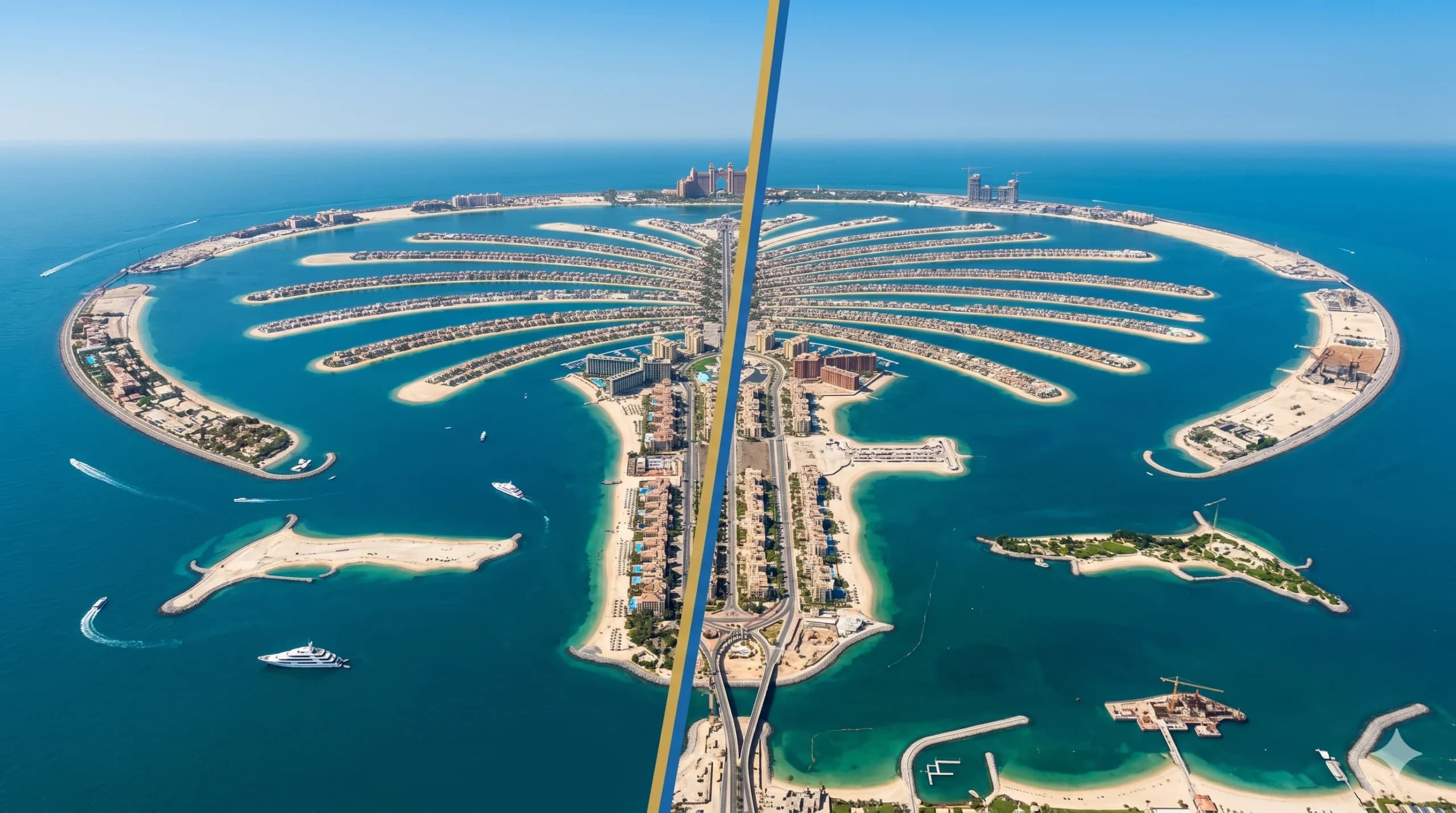
Palm Jumeirah vs Palm Jebel Ali:Which Is the Better Long-Term Investment?
Dubai’s man-made islands have redefined waterfront luxury living, transforming the emirate’s coastline into one of the most recognizable skylines on the planet. Among these engineering marvels, two palm-shaped islands stand out as symbols of ambition and opulence: Palm Jumeirah and Palm Jebel Ali. For investors weighing where to place their capital, the question is no longer hypothetical. Palm Jebel Ali has officially relaunched, and the comparison between these two giants has become one of the most important decisions in Dubai’s luxury real estate market.
This analysis breaks down both islands across every metric that matters to a serious investor—maturity, pricing, rental yields, capital appreciation potential, infrastructure, and long-term outlook—to help you understand which palm deserves a place in your portfolio.
A Tale of Two Islands
Palm Jumeirah: The Established Icon
Palm Jumeirah is Dubai’s original palm-shaped island and arguably its most famous address. Completed in the late 2000s, it has had more than fifteen years to mature into a fully developed, world-class community. Home to luxury villas, branded residences, five-star hotels like Atlantis The Palm, fine-dining restaurants, private beaches, and a vibrant boardwalk at The Pointe, Palm Jumeirah is a proven, cash-generating asset class.
The island spans roughly 5.6 square kilometers and houses tens of thousands of residents. Its trunk, fronds, and crescent are fully built out, leaving very little room for new development. This scarcity is precisely what makes it so valuable. When supply is fixed and demand keeps rising, prices follow a predictable upward trajectory—and that is exactly what Palm Jumeirah has delivered.
Palm Jebel Ali: The Ambitious Successor
Palm Jebel Ali is the bigger, bolder sibling. Originally conceived before the 2008 financial crisis and subsequently shelved, the project was officially relaunched by Nakheel in 2023 with renewed momentum and government backing. At roughly twice the size of Palm Jumeirah, it is designed to eventually accommodate around 35,000 families across a sprawling network of fronds, with an estimated 80 to 110 kilometers of new coastline.
The masterplan promises seven connected islands, luxury beachfront villas, expansive green spaces, mobility-focused infrastructure, and a commitment to sustainability. Where Palm Jumeirah is the finished masterpiece, Palm Jebel Ali is the blank canvas—full of potential but still years away from full realization.
Investment Profile Comparison
Understanding which island suits you begins with understanding what kind of investor you are. These two assets serve fundamentally different strategies.
Maturity and Risk
Palm Jumeirah is a low-risk, mature investment. What you see is what you get. Infrastructure is complete, communities are established, rental markets are deep, and demand is consistently strong. You are buying into a known quantity with a track record spanning more than a decade.
Palm Jebel Ali, by contrast, is a higher-risk, higher-reward proposition. As a largely off-plan development with completion timelines stretching toward the late 2020s and beyond, it carries the typical risks associated with under-construction projects: construction delays, evolving masterplans, and dependence on the developer’s ability to deliver. However, with these risks comes the opportunity to enter at ground-floor pricing before the island matures.
Entry Pricing
This is where the two diverge most sharply. Palm Jumeirah commands premium prices reflective of its established status. Villas on the fronds frequently trade in the tens of millions of dirhams, with signature properties and branded residences reaching even higher. Even apartments command a significant premium per square foot compared to mainland Dubai.
Palm Jebel Ali offers a comparatively lower entry point for waterfront villas at launch pricing. Investors who buy early are positioning themselves to benefit from the appreciation curve that typically accompanies a maturing island. The pricing gap between an early Palm Jebel Ali purchase and a mature Palm Jumeirah property represents the core of the long-term value proposition.
| “The pricing gap between an early Palm Jebel Ali purchase and a mature Palm Jumeirah property represents the core of the long-term value proposition.” |
Capital Appreciation Potential
When evaluating long-term investment, capital appreciation is often the headline consideration. Palm Jumeirah has already delivered extraordinary appreciation for early buyers. Those who purchased during or shortly after the 2008–2009 downturn saw their property values multiply several times over. The island weathered subsequent market cycles and emerged stronger, particularly during the post-pandemic boom when luxury waterfront demand surged.
However, the very success of Palm Jumeirah means that the most dramatic appreciation may already be behind it. Future growth is likely to be steady and reliable rather than explosive—appreciation in the single digits annually, with occasional spikes driven by limited resale supply.
Palm Jebel Ali presents the classic early-mover appreciation opportunity. History suggests that Palm Jumeirah properties roughly doubled or tripled in value from launch to maturity. If Palm Jebel Ali follows even a fraction of that trajectory, early investors stand to capture substantial capital gains over a five-to-ten-year horizon. The combination of low launch pricing, massive scarcity of true beachfront villas, and Dubai’s continued global appeal creates a compelling case for outsized returns—provided the investor has the patience to wait for the island to develop.
Rental Yields and Income Generation
Income-focused investors will find the two islands at opposite ends of the spectrum—at least for now. Palm Jumeirah is an income-producing machine today. With short-term holiday rentals commanding premium nightly rates and long-term tenants willing to pay top dirham for waterfront living, gross rental yields on the island typically range from 5 to 7 percent depending on property type and management. Apartments tend to deliver higher percentage yields, while villas offer prestige and capital growth.
Palm Jebel Ali generates zero rental income until handover. Investors buying off-plan are committing capital with no cash flow during the construction period. Once completed and the community matures, rental yields could become attractive—but that income stream is a future prospect, not a present reality.
Strategic Infrastructure & Lifestyle
Infrastructure and Connectivity
Palm Jumeirah benefits from being fully integrated into Dubai’s transport and lifestyle ecosystem. It is connected to Sheikh Zayed Road via a dedicated monorail and road network, sits close to Dubai Marina and Media City, and offers immediate access to schools, hospitals, retail, and entertainment.
Palm Jebel Ali’s infrastructure is still being built. Located further south toward the Abu Dhabi border, it benefits from proximity to the future Al Maktoum International Airport—poised to become the world’s largest airport—and the broader Dubai South development corridor. As Dubai’s center of gravity gradually shifts southward over the coming decades, Palm Jebel Ali could find itself at the heart of a new growth zone. The catch is that this vision will take years to fully materialize.
Lifestyle and Community
For end-users and lifestyle-driven buyers, Palm Jumeirah offers an immediate, turnkey luxury experience. Residents enjoy established beach clubs, gourmet dining, premium hotels, and a thriving social scene. Palm Jebel Ali promises a next-generation lifestyle built around sustainability, expansive green spaces, and modern community planning, incorporating more open space and longer coastlines.
Supply and Scarcity Dynamics
Palm Jumeirah’s supply is effectively fixed. No new fronds are being added, and the limited resale inventory keeps upward pressure on prices. Palm Jebel Ali will dramatically increase the overall supply of palm-island waterfront property in Dubai. However, the island’s sheer scale and its longer development timeline mean that supply will be released gradually over many years, allowing demand to absorb it.
Investor Profiling
There is no universal winner—only the right fit for your specific portfolio goals.
| Choose Palm Jumeirah if you: | Choose Palm Jebel Ali if you: |
| • Want immediate rental income and cash flow • Prefer a low-risk, proven asset with established demand • Value a turnkey luxury lifestyle with full amenities today • Have the capital to enter at premium pricing • Prioritize stability and capital preservation | • Are seeking maximum long-term capital appreciation • Can commit capital for several years without rental income • Want to enter at lower launch pricing before maturity • Believe in Dubai’s southward expansion & airport corridor • Have a higher risk tolerance and patient outlook |
The Verdict
For long-term investment specifically, the decision hinges on your time horizon and risk appetite. If your definition of long-term is five to ten years and your priority is capturing the appreciation curve from launch to maturity, Palm Jebel Ali offers the more compelling growth story. The early-mover advantage, lower entry pricing, and strategic positioning near Dubai’s future southern hub create genuine upside potential reminiscent of Palm Jumeirah’s own early days.
If, however, you prioritize reliable income, proven performance, and a hedge against development risk, Palm Jumeirah remains the safer and more dependable choice. It is a blue-chip asset that will continue to appreciate steadily while generating strong rental returns, all backed by a track record no new development can match.
A Balanced Strategy: The most sophisticated investors may not need to choose at all. A balanced portfolio could include a mature Palm Jumeirah property for income and stability alongside an early Palm Jibe Ali investment for growth—capturing the best of both worlds while diversifying across Dubai’s most prestigious addresses.
Need Personalized Guidance?
For current availability, projected yields, and tailored portfolio strategies, the Mavia team is ready to help you make an informed decision aligned with your financial goals.
Mavia Insights
Expert analysis and real-time data from the heart of Dubai's real estate market.